

Al Ahram Beverages Advances Local Sourcing and Sustainable Agriculture with 2026 Barley Harvest Season Opening in East Oweinat
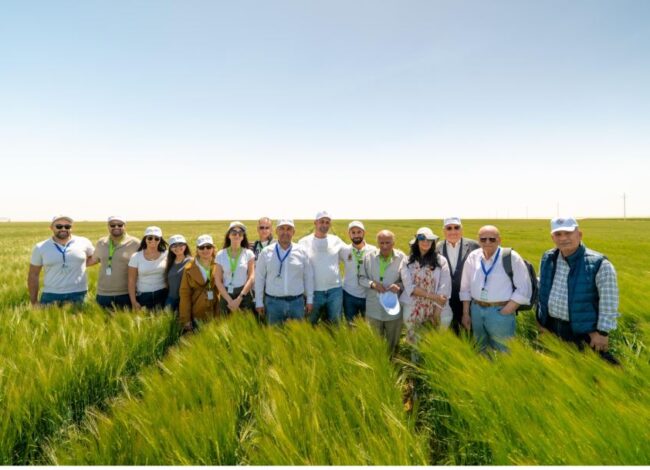
Al Ahram Beverages Company (ABC), in partnership with the Agricultural Research Center (ARC) under the Ministry of Agriculture and Land Reclamation and Sahara Egypt Group, witnessed the opening of the 2026 barley harvest season during a field event held at Sahara Egypt Group farms in East Oweinat.
The event highlights the progress of the Sustainable Barley Cultivation Program, a long-standing multi-stakeholder initiative aimed at advancing local barley cultivation and strengthening the link between scientific research and industrial application.
The program operates through an integrated model that brings together scientific research led by the Agricultural Research Center (ARC), industrial application through Al Ahram Beverages Company and its malt plant, and on-the-ground agricultural implementation in partnership with Sahara Egypt Group.
This approach supports the development of world-class locally grown barley that competes at an international level, while aligning with the requirements of malt production and barley-based beverage production.
The Sustainable Barley Cultivation Program represents one of the key pillars of ABC’s strategy to deepen local production and build more resilient value chains. Today, the company relies on 100% locally grown barley, sourced through a local sourcing system that provides more than 90% of the raw materials used in its operations from the Egyptian market.
This approach supports limiting reliance on imports and strengthening local value creation and reinforces the role of agriculture as a foundation for sustainable industrial growth.
Building on a partnership spanning more than four decades, ABC and ARC formalized their collaboration through an official protocol in 2014 focused on developing high-quality barley varieties and reducing reliance on imports. This cooperation was further expanded in September 2025 through a trilateral agreement with Sahara Egypt Group, aimed at scaling production and aligning agricultural outputs with industrial requirements.
The program includes a comprehensive research component focused on developing new barley varieties, preserving genetic purity, and producing basic seeds for large-scale cultivation. It also incorporates crossbreeding initiatives and specialized studies on water efficiency and carbon footprint reduction to ensure the development of resilient, high yield crops capable of adapting to diverse environmental conditions.
A key pillar of the program is improving water-use efficiency and reducing overall carbon footprint through the adoption of smart agricultural practices, particularly in the early stages of cultivation. These efforts have resulted in estimated annual water savings of approximately 530,000 cubic meters, directly supporting Egypt Vision 2030’s ambition to expand water-efficient practices across agricultural land to 100% by 2030.
The Sustainable Barley Cultivation Program is implemented across nearly 15,000 feddans in multiple agricultural zones across Egypt, selected based on climate, soil conditions, and strategic partnerships. East Oweinat represents one of the program’s primary cultivation sites during the current harvest season.
Through its malt plant in 6th of October City, ABC processes locally grown barley according to the highest technical specifications to meet local market needs, while around 40% of malt production is exported to regional markets. This reflects the ability of Egyptian agriculture and industry to compete in international markets when supported by an integrated system that starts in the field and ends with the final product.
Established in 2005, ABC’s malt plant is the first and only plant of its kind in the Middle East and North Africa, serving as a critical link between agricultural production and industrial output.
The plant holds several internationally recognized certifications in quality, food safety, environmental management, and occupational health and safety, including FSSC 22000 Ver. 6, ISO 9001:2015, ISO 14001:2015, and ISO 45001:2018, in addition to its presence on the National Food Safety Authority’s whitelist, reflecting the company’s commitment to quality standards and compliance.
Beyond production, the plant contributes to circular economy practices by recycling malt by-products, such as barley rootlets and broken grains, for use in animal feed production.
Nikolay Mladenov, Managing Director of Al Ahram Beverages Company, said: “I am pleased and proud to be here today in the heart of the agricultural land to witness the opening of the 2026 barley harvest season. For us, local sourcing is not merely an operational direction, but a strategic choice that reflects our confidence in Egypt’s capabilities and future potential.
Today, we rely on 100% locally grown barley, and more than 90% of our raw materials are sourced from the Egyptian market, because we believe real value starts in agriculture and ends with a product that meets global standards. We remain committed to delivering 100% naturally brewed, high-quality malt beverages that meet international standards.
This direction is not only an operational decision, but a commitment that reflects our confidence in Egypt and our ambition to build more resilient and sustainable local value chains that can support national industry and deliver measurable impact.”
He added, “What distinguishes the Sustainable Barley Cultivation Program is that it presents a clear model for integration between scientific research, industry, and implementation on the ground through our long-standing partnership with the Agricultural Research Center and Sahara Egypt Group.
We are also focused on tangible outcomes, including annual water savings estimated at around 530,000 m3 through improved farming practices and resource management. We clearly see this experience as aligned with state priorities and Egypt Vision 2030, making investment in smart agriculture and water efficiency an essential part of the future of sustainability in Egypt.”
Meanwhile Dr. Maher El Maghraby, Deputy of the Agricultural Research Center and the minister’s deputy for the projects agenda stressed that the partnership between ARC, Al Ahram Beverages Company and Sahara Egypt Group represents a model for the linkage between science and industry to realize national food security and the localization of malt production.
This futuristic vision aims to derive high quality agricultural varieties that are resistant to climate change, which ensures the stability of national industries and counters the challenges of the international supply chains.
And Mr. Mohamed Abd Ellah, Chairman of Sahara Egypt Group said: “It is a pleasure to welcome the leadership of Al Ahram Beverages Company and our partners from the Agricultural Research Center to Sahara Egypt Group’s farms for the opening of the 2026 harvest season. This visit reflects the strong alignment between our shared vision and objectives, and the strength of a partnership built on scientific research and practical implementation.
It also builds on a long history of collaboration, with our farms having hosted similar visits over the years. We are proud of what has been achieved together and look forward to continuing this partnership, building on a solid foundation of trust, knowledge exchange, and a shared commitment to delivering the best possible outcomes.”
This cooperation falls within the framework of supporting Egypt’s strategic national direction toward agricultural investment, encouraging local production, and strengthening public-private partnerships, and supporting food security through sustainable, locally driven value chains that enhance national industry competitiveness.
مواضيع متعلقة
- «چذور» تستعرض مشروعي «نيو» و«جي إيست» خلال معرض The Direct Expo
- فورتينت وبالو ألتو: الأمن السيبراني والذكاء الاصطناعي في صدارة التحول الرقمي خلال CAISEC 2026
- إي فاينانس: الأمن السيبراني ركيزة حماية المدفوعات الحكومية وتعزيز الثقة في الاقتصاد الرقمي
- «جهينه» تطرح مشروب الطاقة «جوريلا إنرجي» العالمي في السوق المصرية